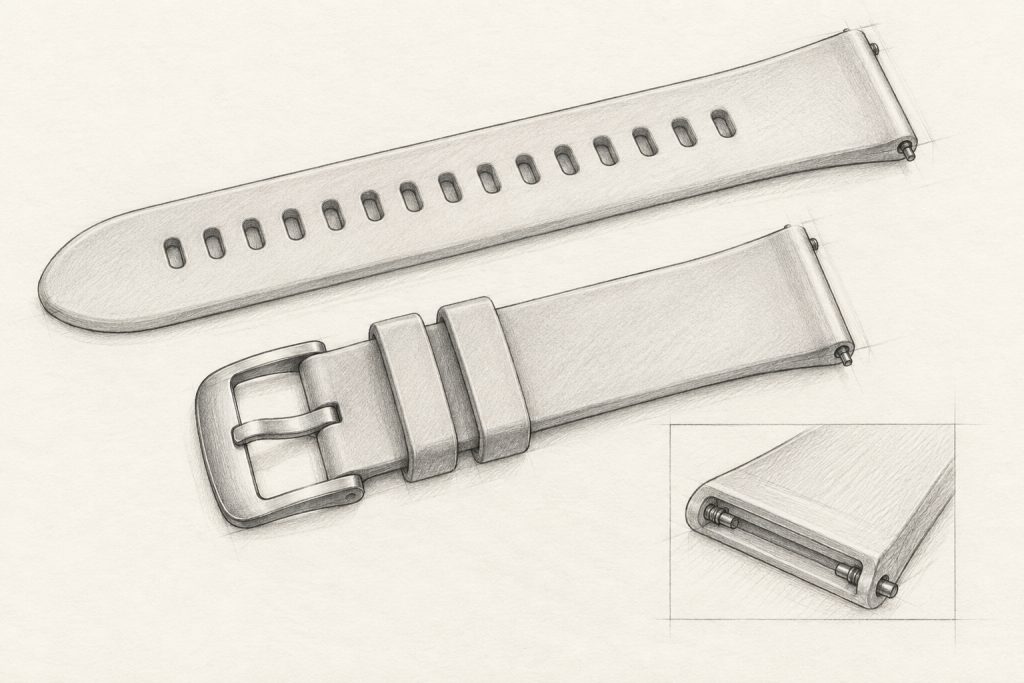
For a custom silicone watch strap, appearance is only one part of the brief. The strap must connect correctly to the watch, adjust to the intended wrist range and work with its buckle. Two straps with the same advertised width can still have different attachment geometry.
Use this guide to prepare a design review for a branded accessory, replacement-strap project or new watch collection. Tooling availability and feasibility should be confirmed for the exact design. The pencil drawing is a generic concept, not an engineering drawing or a compatibility claim.
Define which watch the strap must fit
Identify the exact watch model or supply the case drawing and a physical reference where possible. For a straight-end strap, record the gap between the lugs, the spring-bar arrangement and the available clearance around the attachment. For a proprietary connector, a width measurement alone is not enough.
Label dimensions in millimetres and identify how they are measured. A brief marked “20 mm” still needs to explain whether this is the watch-side width or the buckle-side width. These can differ on a tapered strap. Do not describe an untested design as universally compatible.
Choose length around the wearer and watch case
Specify the short and long sections separately, state whether the buckle is included in the quoted length, and show the adjustment-hole range. The watch case contributes to the assembled fit, so strap length alone does not determine the wrist circumference it can accommodate.
Ask for an assembled fit check on the intended case. At the tighter setting, confirm that the tail can sit neatly through the keepers. At the looser setting, confirm secure fastening and enough usable adjustment. If a wide wrist range is needed, discuss separate length options rather than promising one size for everyone.
Review thickness, flexibility and surface together
A thin, flexible strap and a substantial, structured strap create different experiences. Share a reference for the feel you want, then review thickness, material hardness, underside texture and edge shape as a combination. A hardness number on its own does not describe the feel of the finished geometry.
Discuss plain surfaces, textured panels or ventilation features according to the intended use. These features still need checks for comfort, cleanability and strength around holes. Silicone, FKM and other materials sold as “rubber” are not interchangeable specifications; name the material required in the enquiry.
Include the buckle, keepers and pins in the brief
- Buckle: specify the style, buckle-end width, finish and how the tang meets the adjustment holes.
- Keepers: agree their number, position and how firmly they retain the strap tail.
- Attachment hardware: show spring-bar or connector dimensions and the insertion arrangement. Confirm whether hardware is included.
- Branding: mark the logo location, actual size and whether it is molded or printed. Keep details clear of functional contact areas unless specifically engineered.
For an explanation of graphic finishes, see our printing versus color-filling guide. A visual finish should be evaluated on the actual strap material and geometry.
Approve a functional sample before bulk production
A render can show proportions and branding. It cannot establish secure fit. Review a physical sample assembled with the intended watch and hardware before agreeing the production specification.
- Check attachment seating, clearance and retention using the agreed inspection method.
- Inspect hole edges, molded surfaces, thickness and parting lines.
- Check buckle engagement, adjustment and keeper behavior across the intended fit range.
- Agree relevant flexing, pull, rubbing and exposure checks for the actual use case; define acceptance criteria rather than assuming a test result.
- Confirm color, finish, packaging and identification of compatible versions.
Claims about skin compatibility, chemical resistance or service life need supporting evidence for the finished specification. The strap material alone does not establish the water resistance of an assembled watch.
Prepare an OEM enquiry that can be reviewed
Send the target case/model, connector drawing or sample, both strap-section lengths, watch-side and buckle-side widths, thickness profile, adjustment range, material preference, color, logo artwork, hardware list, quantity per version and delivery destination. Request feasibility review, sample/tooling cost, unit price and a schedule based on the agreed design.
Common questions
Will any strap with the same width fit?
No. Attachment geometry, pins, thickness and case clearance also matter. Confirm compatibility on the intended watch.
Can an existing strap be the reference?
A physical reference helps communicate dimensions and feel. Specify the changes you want and provide artwork you have permission to use.
Can you confirm price from a pencil sketch?
A sketch can start the discussion, but a meaningful production quote needs dimensions, connector details, quantity and hardware requirements.
Send your watch strap brief for a feasibility and quotation review. Explore our silicone customization service or compare the separate requirements for custom silicone wristbands.